
We have over $10 million in fund cash and uncalled investor commitments ready to invest. Despite reviewing 20 to 30 deals a week, we have zero deals under signed LOI.
That's frustrating. We want to put capital to work, and many of our investors are understandably eager for us to do so. But the bar for a good real estate investment moved higher in Q3.
The bar went up in Q3
The 10-year Treasury yield averaged 4.60% in July, 4.99% in September, and 5.13% in October. It has since eased to just under 4.9%.
Higher yields make debt more expensive. They also raise the hurdle. When investors can earn close to 5% in Treasuries, a private real estate deal has to offer enough additional return to justify its illiquidity, leverage, and execution risk. They aren't directly comparable investments, but the Treasury yield sets a floor every risk asset must clear.
Prices haven't caught up
Commercial real estate cap rates have started to rise, which means some deals are getting cheaper. Just not as fast as rates rose.
CBRE estimates the average cap rate sits only about 160 basis points above a 5% 10-year Treasury. That's a record low, roughly half the long-run average difference of 325 basis points. For multifamily and industrial, the spread is under 100 basis points. Spreads are wider for prime office and retail, which is where CBRE (and Wellings) sees more room for opportunity. That doesn't tell us the total return on a particular investment, but it does suggest buyers have less room for error at today's pricing.
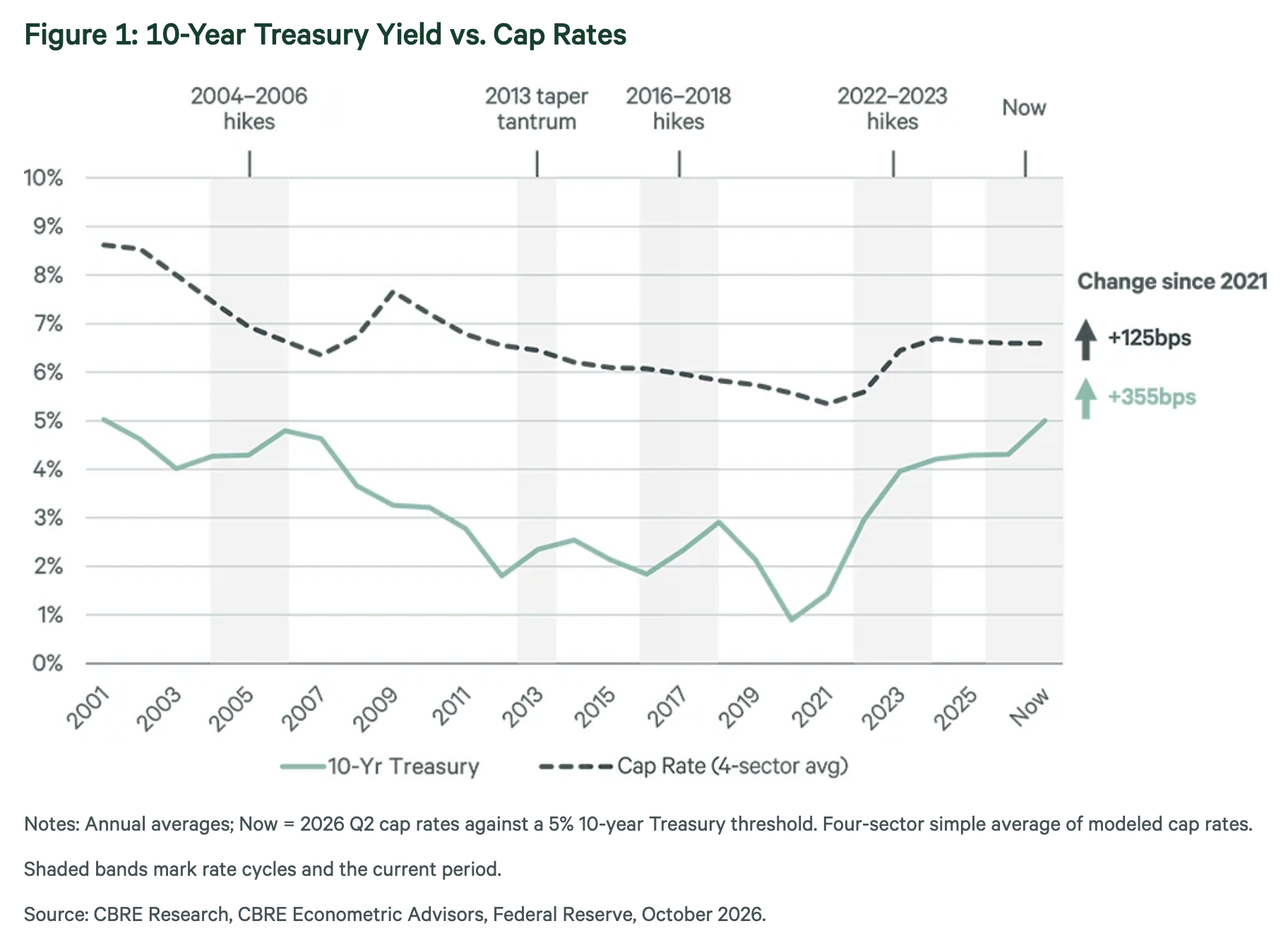
That matches what we see. In many of the opportunities we review, sellers' pricing hasn't fully adjusted to higher financing costs and return requirements.
Rate volatility makes it harder. A deal can pencil when you sign the contract. If rates jump before closing 60 to 90 days later and the seller won't adjust the price, the deal dies.
Sources: Federal Reserve Bank of St. Louis (FRED), CBRE
What We’re Seeing in our pipeline
We've come close on several deals recently. None has reached a signed LOI.
We're seeing interesting opportunities, but an interesting property and an attractive investment at the proposed price are two different things.
One recapitalization opportunity we passed on illustrates why we're selective. The sponsor's proposed structure would have directed roughly 75% of our preferred equity investment toward sponsor liquidity, while existing property income covered only 91% of combined senior debt service and preferred equity current payments.
The business plan depended on significant NOI growth to make the numbers work.
We passed.
The question we keep coming back to: Does the return still work if interest rates and exit cap rates don't improve?
What would change that? Sellers adjusting prices to reflect today’s rates. Rates settling enough that financing becomes predictable again. Owners facing loan maturities who need to sell. We can’t predict the timing, but when it happens, we want capital ready.
The Cost of Waiting
Passing on deals isn't free.
For investors with uncalled commitments, waiting creates uncertainty about when they'll need liquidity. And we recognize that some deals we pass on may ultimately perform well.
We take that seriously. But a deal shouldn't clear our underwriting simply because we've been waiting longer than expected.
Why the purchase price matters
In May 2023, one of our funds invested $1 million in a Fairfax, Virginia shopping center that was more than 25% vacant. The plan was to lease that space within two years.
It took two and a half years to sign a major tenant, who still hasn't opened.
Yet the property has paid our fund an average of approximately 9% cash-on-cash annually since acquisition.
Existing rental income, fixed-rate debt, and a favorable purchase price kept distributions flowing through the delays. The final return still depends on the eventual sale, but the basis gave the deal room to fall behind schedule.
The price you pay determines how much has to go right to get the projected returns.
A real tension
Wellings grows by raising and investing capital. Our investors want their capital working, and so do we.
We won't always get these decisions right. We may pass on opportunities that turn out well. But we'd rather explain why capital is still waiting than explain why we lowered our standards to deploy it.
Thank you for entrusting us with your capital. If you have questions about anything in this commentary, or about how we are viewing opportunities right now, please contact us or schedule a call.
DISCLAIMER: Past performance is not indicative of future results. There is no guarantee that any forecasts or projections will be achieved. Any investment involves significant risk, including the possible loss of principal. Investors should carefully consider the investment objectives, risks, charges, and expenses of any Wellings Capital Management, LLC (“Wellings”) investment program. Offering documents containing this and other important information are available by calling 800.844.2188, emailing invest@wellingscapital.com, or visiting wellingscapital.investnext.com.
The information in this article is for informational purposes only and does not constitute an offer to sell or a solicitation of an offer to buy any securities in any jurisdiction where such an offer or solicitation would be unlawful. Wellings does not provide tax, legal, or accounting advice. Investors should consult their own advisors regarding any investment. Information and any opinions contained in this article have been obtained from sources that we consider reliable, but we do not represent that such information and opinions are accurate or complete and thus should not be relied upon as such.